
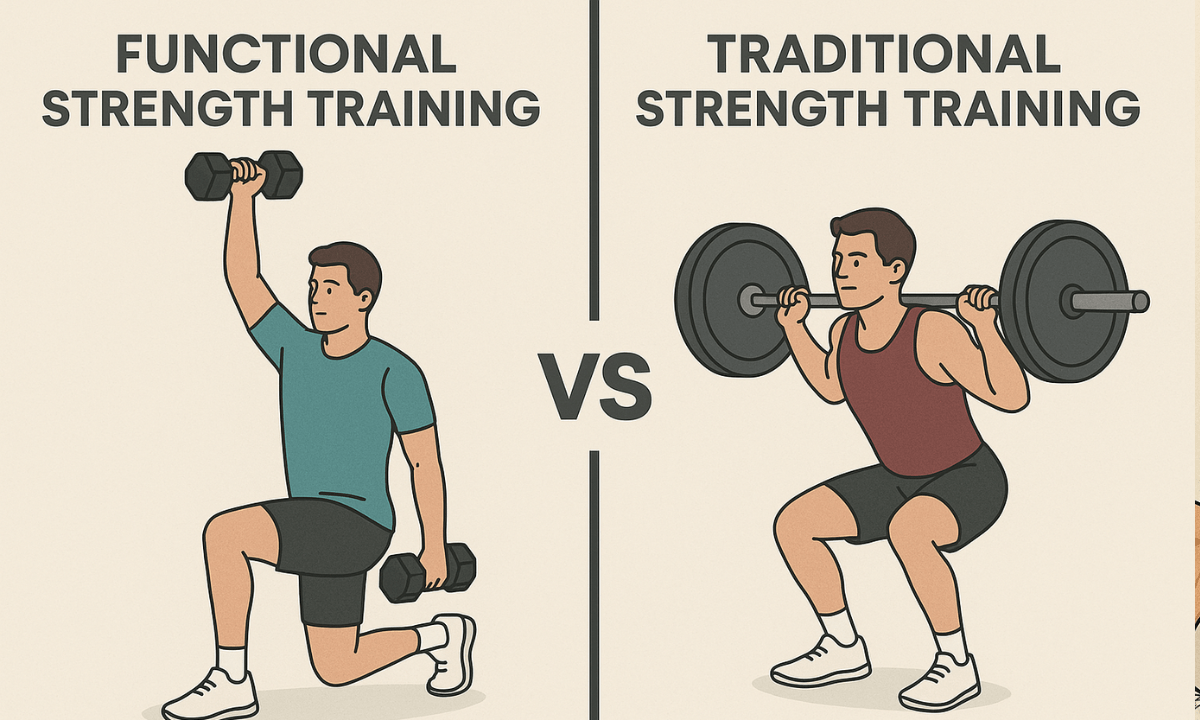
Introduction: Functional Strength Training vs Traditional
Strength training has been a cornerstone of fitness for centuries, evolving from ancient practices of lifting stones and carrying heavy loads to today’s highly specialized gym workouts. At its core, strength training refers to any activity that improves muscular strength, endurance, and overall performance by applying resistance against muscles. Whether you’re picking up a barbell, doing push-ups, or carrying groceries up the stairs, you’re engaging in strength training in one form or another.
Over time, different training philosophies have emerged to address the needs of diverse populations. For example, athletes seek explosive power, while office workers may simply want to reduce back pain. This demand led to the development of two major categories: functional strength training and traditional strength training. While both approaches aim to make you stronger, they do so through different principles, movement patterns, and goals.
Traditional strength training has long dominated gyms, focusing heavily on isolated muscle groups, progressive overload, and building raw strength or muscle mass. Think of the bench press, squats, deadlifts, and curls—these are staples in any traditional workout plan. On the other hand, functional strength training emphasizes movements that mimic real-life activities, training multiple muscle groups together to enhance coordination, mobility, and balance.
The question most people ask is: Which one is better? The answer isn’t that simple. It depends on your lifestyle, goals, and fitness background. To help you make an informed choice, let’s break down what each training style offers, how they differ, and why you might choose one—or combine both—for the best results.

Understanding Functional Strength Training
Functional strength training is all about preparing your body for the movements you perform in daily life. Instead of isolating one muscle at a time, it emphasizes compound, multi-joint movements that build strength, coordination, and stability simultaneously. For example, a squat with a medicine ball isn’t just about leg strength—it challenges your core, balance, and posture, making it directly transferable to activities like bending to pick something up or climbing stairs.
The core principles of functional training revolve around natural body mechanics. Movements are performed in multiple planes of motion—sagittal (forward and backward), frontal (side to side), and transverse (rotational)—rather than sticking to one. This makes the body more adaptable and resilient. Unlike traditional methods that rely heavily on machines and fixed equipment, functional training often uses tools like kettlebells, resistance bands, medicine balls, and bodyweight exercises.
Key exercises in functional training include kettlebell swings, TRX rows, farmer’s carries, planks, Bulgarian split squats, and rotational medicine ball throws. These moves engage stabilizing muscles, improve core control, and mimic real-life physical challenges.
The benefits of functional strength training are vast. It enhances balance and coordination, reduces the risk of injuries, improves posture, and increases overall mobility. Athletes often use functional training to replicate sports-specific movements, while everyday people find it useful for making daily activities easier and safer. For example, an older adult who practices functional training may find it easier to get out of a chair, carry groceries, or play with their grandchildren without discomfort.
Ultimately, functional training equips you with strength that translates directly into life outside the gym. It’s not just about looking strong—it’s about being strong in ways that matter most.
Exploring Traditional Strength Training
Traditional strength training, also known as resistance or weight training, is the more structured and widely recognized approach in gyms. It emphasizes progressive overload—gradually increasing the weight, sets, or repetitions to stimulate muscle growth and strength gains. The goal is often either hypertrophy (muscle size), maximal strength, or muscular endurance, depending on how the program is structured.
The core principles of traditional training include isolation exercises and compound lifts. Isolation exercises, like bicep curls or leg extensions, target specific muscles to enhance size and shape. Compound lifts, such as squats, deadlifts, and bench presses, work multiple muscles but still focus on maximizing load and strength. Unlike functional training, traditional methods often prioritize linear progression: you get stronger by lifting heavier over time.
Key exercises in traditional training revolve around barbells, dumbbells, and machines. Popular choices include bench presses for chest, squats for legs, lat pulldowns for back, and shoulder presses for delts. Machines, in particular, guide your range of motion, making it easier for beginners to lift without worrying about form or balance.
The benefits of traditional training are undeniable. It’s one of the best methods for building muscle mass, improving bone density, increasing raw strength, and sculpting the body. Bodybuilders, powerlifters, and many athletes rely heavily on traditional training principles to achieve their goals. Additionally, traditional strength training plays a vital role in long-term health by reducing the risk of osteoporosis, boosting metabolism, and supporting healthy aging.
However, its emphasis on isolated movements and heavy loads can sometimes make it less practical for daily functionality. For example, being able to leg press 500 pounds on a machine doesn’t necessarily mean you can carry groceries up the stairs without strain. That’s where functional training often fills the gap.
Key Differences Between Functional Strength Training vs Traditional
While both functional and traditional strength training aim to make you stronger, their methods and applications are fundamentally different. Understanding these differences will help you decide which approach better suits your goals.
-
Training Objectives
-
Functional training focuses on enhancing real-world movement efficiency, balance, and agility. It’s about the strength you can use in everyday life.
-
Traditional training emphasizes hypertrophy, strength gains, and muscle isolation for aesthetics or sport-specific power.
-
-
Muscle Engagement and Movement Patterns
-
Functional training works multiple muscle groups at once through compound, dynamic movements in various planes of motion.
-
Traditional training often isolates muscles and uses controlled, repetitive movements, typically in a single plane.
-
-
Equipment Used
-
Functional training relies on free weights, kettlebells, resistance bands, medicine balls, and bodyweight.
-
Traditional training uses barbells, dumbbells, weight machines, and structured gym equipment.
-
To illustrate, imagine two people training:
-
Person A does a kettlebell lunge with rotation (functional training). They’re improving balance, core stability, and coordination—all at once.
-
Person B does a seated leg press (traditional training). They’re isolating leg muscles to lift as much weight as possible, focusing purely on strength and hypertrophy.
Both are valid, but the choice depends on whether your goal is daily functionality or muscle development and raw power.
Pros and Cons of Each Approach
No training method is perfect—each comes with unique advantages and limitations. Let’s break them down:
Advantages of Functional Training
-
Enhances balance, stability, and coordination.
-
Reduces injury risk by strengthening stabilizing muscles.
-
Improves flexibility and mobility.
-
Makes daily activities easier and safer.
-
Engages the core in nearly every exercise.
Drawbacks of Functional Training
-
Harder to measure progress compared to lifting heavier weights.
-
It may not maximize muscle growth or hypertrophy.
-
Requires good technique and body awareness to avoid injury.
-
It can feel less structured for those who prefer linear progression.
Advantages of Traditional Training
-
Excellent for building muscle mass and strength.
-
Easier to track progress with clear numbers (weight, reps, sets).
-
Provides a wide variety of equipment and structured programs.
-
Supports bone density and long-term health.
-
More effective for bodybuilding or strength sports.
Drawbacks of Traditional Training
-
Can neglect balance, coordination, and functional strength.
-
Over-reliance on machines reduces stabilizer muscle engagement.
-
Higher risk of repetitive strain injuries if not balanced with mobility work.
-
It may not always translate into improved performance in daily life.
In short, functional training makes you “life strong,” while traditional training makes you “gym strong.” The best approach depends on what kind of strength you value most.
Which Style is Best for You?
Choosing between functional strength training and traditional strength training depends on your personal fitness goals, lifestyle, and physical condition. There’s no universal “best” option—what works for one person may not be ideal for another. The key lies in understanding your priorities and tailoring your training accordingly.
If your goal is overall health, mobility, and day-to-day strength, functional training may serve you better. For example, older adults, athletes, and individuals recovering from injuries often find functional training more practical because it focuses on balance, coordination, and core stability. It prepares you for real-world movements, such as lifting groceries, climbing stairs, or even chasing after kids.
On the other hand, if your goal is muscle growth, aesthetics, or raw power, traditional training shines. Bodybuilders, powerlifters, and gym enthusiasts who want defined muscles and increased lifting ability typically lean toward traditional strength training. The structure of progressive overload makes it easier to track progress and push limits over time.
But here’s the good news: you don’t have to choose one over the other. Many fitness professionals recommend a hybrid approach, combining elements of both. For example, you might perform heavy barbell squats (traditional) for strength, then add kettlebell lunges with rotation (functional) to improve balance and real-world performance.
When deciding which style fits you best, consider factors like:
-
Age: Younger individuals may focus on muscle growth, while older adults may prioritize mobility and joint health.
-
Fitness Level: Beginners often start with traditional training for simplicity, while advanced athletes incorporate functional training for versatility.
-
Lifestyle Goals: Do you want to run faster, play sports better, or simply look good in the mirror? Your answer will guide your choice.
Ultimately, the best training program is one that keeps you consistent, motivated, and progressing toward your unique goals.
Functional Training for Athletes
Athletes across all sports are turning to functional strength training because it directly enhances performance. Unlike traditional training, which isolates muscles, functional training replicates the dynamic, multi-directional movements required in sports. This makes it invaluable for improving agility, coordination, and explosive power.
For example, a basketball player needs to jump, sprint, twist, and pivot—all in rapid succession. Functional exercises such as box jumps, lateral lunges, and rotational medicine ball throws mimic these demands, making the athlete stronger and more resilient on the court. Similarly, a soccer player benefits from single-leg stability exercises like Bulgarian split squats, which improve balance and reduce injury risk during quick directional changes.
One of the greatest benefits of functional training for athletes is injury prevention. Sports often place athletes in unpredictable positions, and functional training strengthens stabilizer muscles that protect joints from strain. Exercises that engage the core, hips, and shoulders are particularly important because they build the foundation for efficient movement.
Examples of functional exercises for athletes include:
-
Kettlebell swings for explosive hip drive.
-
TRX rows for upper-body pulling strength and core stability.
-
Agility ladder drills for footwork and speed.
-
Rotational medicine ball slams for power in twisting movements.
By integrating these into their training, athletes not only get stronger but also more athletic in the truest sense—able to move fluidly, efficiently, and powerfully in real-world scenarios.
Traditional Training for Bodybuilders
For bodybuilders and those chasing muscle aesthetics, traditional strength training is the gold standard. The structured, progressive overload system of traditional training allows for precise targeting of muscle groups, making it ideal for hypertrophy.
Unlike athletes, who train for performance, bodybuilders train for size, symmetry, and definition. Isolation exercises such as bicep curls, tricep pushdowns, and leg extensions allow them to sculpt each muscle with precision. Compound lifts like squats, bench presses, and deadlifts serve as the foundation, building mass and strength across major muscle groups.
The benefits of traditional training for bodybuilders are immense:
-
Hypertrophy: Controlled movements with moderate to heavy weights create the muscle tension necessary for growth.
-
Progress Tracking: By recording sets, reps, and weights, progress is easy to measure.
-
Muscle Symmetry: Isolation exercises help ensure balanced muscle development.
-
Aesthetic Results: Traditional training remains unmatched for those looking to “build a physique.”
This doesn’t mean bodybuilders ignore functionality altogether. Many add mobility drills or core training to support heavy lifts. However, their primary focus is building visible muscle mass and maximizing strength, which traditional training delivers exceptionally well.
In short, traditional strength training is the backbone of bodybuilding—providing the structure, focus, and results necessary for those who want to shape their physique into a work of art.
Injury Prevention and Recovery
One of the most overlooked aspects of training is how it contributes to injury prevention and rehabilitation. Here’s where the differences between functional and traditional training become crystal clear.
Functional training shines when it comes to preventing injuries. By focusing on stabilizing muscles, joint mobility, and movement efficiency, it strengthens the weak links in the body. For instance, exercises like single-leg Romanian deadlifts or planks not only build strength but also train balance and control, which reduces the likelihood of falls and sprains. This is especially beneficial for athletes and older adults, who face higher risks of injury in daily activities.
Meanwhile, traditional training is equally valuable in its own way. Heavy resistance exercises like squats and deadlifts improve bone density, tendon strength, and muscular resilience, which can safeguard the body against long-term issues like osteoporosis. Furthermore, controlled isolation movements allow for rehabilitation after injuries, as they let you strengthen specific muscles without overloading the entire body.
For example:
-
After a knee injury, isolation leg extensions (traditional) help rebuild quadriceps strength.
-
To prevent that injury in the first place, balance drills and stability exercises (functional) would have strengthened the supporting muscles around the knee.
The smartest approach is to combine both. Functional training addresses movement quality and stability, while traditional training reinforces muscular and skeletal strength. Together, they create a balanced, injury-resistant body capable of long-term performance.
Time Efficiency and Training Frequency
In today’s busy world, many people want to know: which training style saves more time? The answer depends on what you’re trying to achieve.
Functional training tends to be time-efficient because it combines multiple benefits in a single workout. A circuit of kettlebell swings, planks, and walking lunges simultaneously targets strength, balance, core stability, and cardio endurance. In as little as 30–45 minutes, you can get a full-body, well-rounded session. For people with hectic schedules, this makes functional training appealing.
Traditional training, while incredibly effective, often requires longer sessions. Since it focuses on isolated muscle groups, workouts are typically divided into “splits” (e.g., chest day, back day, leg day). This means training frequency is higher—four to six days per week—for optimal results. A single session might last 60–90 minutes, especially if rest periods between heavy lifts are factored in.
That said, traditional training also allows for more precise control of volume and intensity, making it better for individuals with long-term bodybuilding or strength goals.
In summary:
-
Functional training is great if you’re short on time and want a “bang for your buck” session that hits everything at once.
-
Traditional training works best if you can commit more time weekly and want structured muscle growth or strength gains.
The decision ultimately depends on how much time you can realistically dedicate to training each week.
Scientific Research and Studies
Scientific research has shed a lot of light on both functional and traditional strength training, highlighting their unique benefits and roles in fitness. Numerous studies have compared the two, and the results are fascinating.
For functional training, research consistently shows improvements in balance, coordination, and core stability. A study published in the Journal of Strength and Conditioning Research found that individuals who followed a functional training program experienced significant gains in agility and movement efficiency compared to those who trained with machines. Another study highlighted how functional training helps older adults maintain independence by improving mobility and reducing fall risks. These findings underscore its importance for both athletic performance and everyday health.
On the flip side, traditional strength training has an overwhelming body of research supporting its effectiveness for hypertrophy and raw strength. Studies confirm that progressive overload using free weights or machines is the most efficient way to increase muscle size and bone density. For instance, a meta-analysis in Sports Medicine showed that traditional resistance training outperformed other forms of exercise for building lean muscle mass and improving metabolic health.
Interestingly, when researchers examined combined approaches, they found that mixing functional and traditional training often produced the best results. Athletes, for example, benefited from traditional strength training to build power, while functional training helped them transfer that strength into real-world or sport-specific movements.
In conclusion, science doesn’t favor one style exclusively. Instead, it reveals that each has unique strengths, and together they form a well-rounded fitness regimen.
Common Myths and Misconceptions
When it comes to functional and traditional strength training, misinformation often clouds the discussion. Let’s bust some of the most common myths.
“Functional Training is Only for Athletes”
This couldn’t be further from the truth. While athletes use functional training to improve sports performance, it’s just as beneficial for everyday people. Functional exercises help office workers combat poor posture, seniors maintain mobility, and parents carry their kids without back pain. In reality, anyone who wants to move better in daily life can benefit from functional training.
“Traditional Training is Outdated”
Some fitness enthusiasts argue that machines and barbells are no longer necessary in today’s “functional fitness” era. But this is misleading. Traditional strength training remains the gold standard for muscle growth and raw strength. Without it, achieving bodybuilding goals or maximum power output would be nearly impossible. Far from being outdated, it continues to evolve with new programming strategies and scientific insights.
“You Have to Choose One Style”
This is perhaps the biggest misconception. Many believe you must pick either functional or traditional training. In reality, the two complement each other beautifully. For example, barbell squats (traditional) build powerful legs, while walking lunges with rotation (functional) make those legs more useful in real-world settings. Together, they create a stronger, more capable body.
“Functional Training Doesn’t Build Muscle”
While functional training may not maximize hypertrophy like traditional methods, it still builds lean muscle. Exercises such as kettlebell swings, push-ups, and Bulgarian split squats stimulate growth while also improving stability and endurance. It’s not about “no muscle”—it’s about balanced muscle development.
By separating fact from fiction, it becomes clear that both functional and traditional training have a rightful place in modern fitness.
Real-Life Applications
The most important question is: how do these training methods actually apply to real life?
Functional strength training prepares your body for the challenges of everyday living. Think about lifting heavy grocery bags, playing with kids, climbing stairs, or even shoveling snow. Functional exercises mimic these movements, training multiple muscles together so you can perform them with ease and without injury. For example:
-
Farmer’s carries improve your grip and core, making grocery runs easier.
-
Squats build lower-body strength for sitting, standing, or lifting safely.
-
Rotational exercises help with tasks like reaching across the car or twisting while carrying something.
On the other hand, traditional strength training may not always mimic daily activities, but it has equally important real-life benefits. Building muscle mass increases your resting metabolism, which helps control weight. Strengthening bones through resistance exercises reduces the risk of osteoporosis and fractures later in life. For individuals in physically demanding jobs, like construction or firefighting, the raw strength gained from traditional training is invaluable.
For athletes, combining both approaches translates directly to improved performance. For non-athletes, it means greater strength, resilience, and confidence in daily movements. In short, functional training makes life’s tasks easier, while traditional training makes your body stronger and healthier over the long term.
Combining Functional and Traditional Training
Instead of viewing functional and traditional training as rivals, think of them as partners. A hybrid workout plan allows you to reap the benefits of both.
The idea is simple: use traditional training for muscle and strength, then functional training to apply that strength in real-world scenarios. For example, a weekly workout split might look like this:
Sample Weekly Hybrid Training Split
-
Day 1: Traditional (Upper Body Strength) – Bench press, rows, shoulder press, bicep curls.
-
Day 2: Functional (Full-Body Mobility & Core) – Kettlebell swings, TRX rows, planks, lateral lunges.
-
Day 3: Rest or Active Recovery (yoga, walking).
-
Day 4: Traditional (Lower Body Strength) – Squats, deadlifts, leg press, calf raises.
-
Day 5: Functional (Athletic Conditioning) – Agility ladder drills, medicine ball slams, single-leg balance work.
-
Day 6: Traditional (Accessory & Isolation) – Arm, chest, or back focus.
-
Day 7: Rest.
This approach balances aesthetics, strength, and functionality. You get the structured progression of traditional training while also developing the agility, balance, and mobility from functional training.
In the long run, such a program creates a body that looks good, performs well, and stays injury-free.
Final Thoughts
The debate of functional strength training vs traditional training doesn’t have a clear “winner.” Instead, it comes down to your personal goals. If you want to build raw strength and muscle, traditional training is your go-to. If your goal is to move better, reduce injuries, and improve everyday performance, functional training is ideal.
But here’s the takeaway: you don’t have to choose one exclusively. The smartest approach is to combine the two, creating a program that enhances both your physique and your real-world capabilities. Strength isn’t just about lifting weights—it’s about living life fully, without limitations.
FAQs
1. Can beginners start with functional training, or should they begin with traditional strength training?
Beginners can start with either. Traditional training is easier to track and provides structure, while functional training improves movement quality. A mix of both is often the best choice.
2. Is functional training better for weight loss than traditional training?
Functional training tends to burn more calories in shorter sessions because it engages multiple muscle groups and often includes cardio elements. However, traditional training builds muscle, which increases long-term calorie burn.
3. Can I build big muscles with functional training alone?
Yes, but muscle growth may be slower compared to traditional training. Functional training emphasizes balanced strength and endurance, while traditional methods focus directly on hypertrophy.
4. How many days a week should I train functionally vs traditionally?
A good balance is 2–3 traditional sessions and 2 functional sessions per week, depending on your goals. Athletes may lean more toward functional, while bodybuilders prioritize traditional.
5. Do I need special equipment for functional training?
Not necessarily. Many functional exercises use bodyweight, resistance bands, or household objects. However, kettlebells, TRX bands, and medicine balls can enhance variety and effectiveness.

